Hotel Trópico Latino
 September 8, 2026

Costa Rica is one of the more approachable countries in Central America for first-time visitors. Entry is straightforward, English is widely spoken in tourist areas, and the infrastructure for travel is developed enough to be reliable. That said, a few things work differently than travelers expect — and getting clear on them before you arrive makes the trip significantly smoother.
This guide covers the practical basics: entry, getting around, what to pack, which regions to consider, and why the Nicoya Peninsula — and Santa Teresa specifically — is one of the strongest choices for a first visit.
Most visitors from North America and Europe enter Costa Rica without a visa for stays of up to 90 days. You’ll need a valid passport, a return or onward ticket, and proof of sufficient funds for your stay. The official guideline is around $100 per day, though this is rarely verified in practice.
The two main international airports are Juan Santamaría (SJO) in San José and Daniel Oduber Quirós (LIR) in Liberia. SJO handles more international connections and is the standard entry point. LIR is the better option if your destination is Guanacaste or the Nicoya Peninsula — it eliminates several hours of overland travel.
No vaccinations are required for entry. The water is safe to drink in most urban areas; bottled water is common in rural and coastal zones.
Costa Rica has no domestic rail network. Movement between destinations is by road, boat, or domestic flight — and road travel takes significantly longer than distances on the map suggest.
Rental cars are widely available and give the most flexibility. A 4×4 is recommended for secondary roads, particularly during the green season (May–November) when dirt routes get muddy. Google Maps works well on main routes but occasionally misses road conditions on unpaved stretches. Driving at night in rural areas is not recommended.
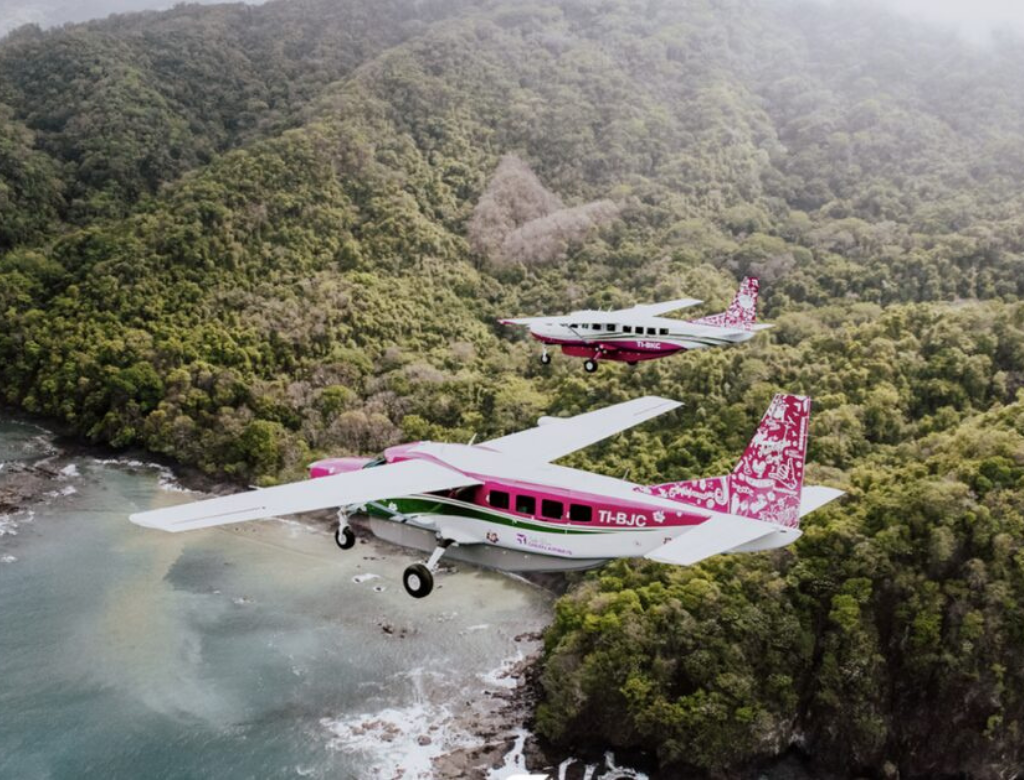
Domestic flights are the most practical solution for multi-destination trips. Costa Rica Green Airways and Sansa Airlines both connect San José with Cobano — the closest airstrip to Santa Teresa — as well as Quepos (Manuel Antonio), Palmar Sur (Osa Peninsula), and other destinations. A flight that takes under 30 minutes replaces a 4–5 hour road and ferry journey.
The Puntarenas–Paquera ferry is the standard route for travelers heading to the Nicoya Peninsula by road. The crossing takes about 1.5 hours and runs multiple times daily. From Paquera, it’s another 1.5–2 hours by road to Santa Teresa. Plan for 4–5 hours total from San José.
Shared shuttles connect major destinations and drop passengers at hotels rather than bus stations. More comfortable than public buses and significantly cheaper than private transfers.
Clothing: Light and breathable. The coast is hot year-round. A packable rain jacket is essential during green season for afternoon showers. Trail shoes or hiking sandals for nature walks; flip flops for the beach.
Sun protection: Reef-safe sunscreen is strongly recommended — conventional formulas with oxybenzone damage coral reefs, and Costa Rica’s marine protected areas depend on visitors making the switch. Bring enough from home; quality reef-safe options are harder to find locally.
Insect repellent: With DEET or picaridin. Mosquitoes are present year-round, more so during the rainy season.
Electronics: No adapter needed — Costa Rica uses the same outlets as the US (Type A and B, 110V). Cell service is good along the coast and in urban areas; more remote zones have limited coverage.
Costa Rica’s regions offer genuinely different experiences. A first visit that tries to cover everything typically ends up rushing through all of them. Two or three regions in ten days is the right pace.
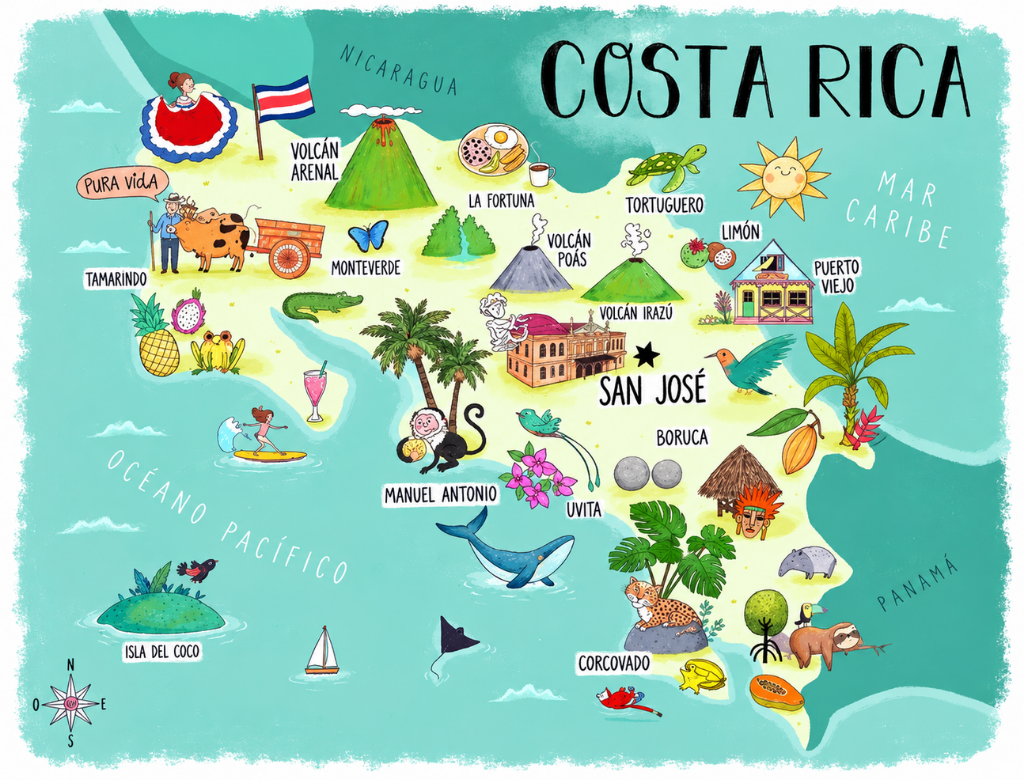
Nicoya Peninsula (Santa Teresa, Nosara, Sámara): The Blue Zone region of the country. Surf-focused, wellness-oriented, and increasingly well-known without yet losing its independent character. Santa Teresa in particular offers a combination of beachfront access, surf, yoga, wildlife, and dining that works for a wide range of travelers. One of the strongest recommendations for first-time visitors who want the “real Costa Rica” feel without extreme remoteness.
Guanacaste: Developed beach infrastructure, consistent dry-season weather, and easy access from Liberia airport. Best for travelers who want beaches with full amenities and a resort option. Fly into LIR.
Central Pacific (Manuel Antonio, Jacó, Dominical): Good balance of beach, wildlife, and accessibility from San José. Manuel Antonio National Park is one of the most visited in the country — wildlife sightings are reliable and the beach inside the park is genuinely beautiful.
Arenal / La Fortuna: Volcano, hot springs, white-water rafting, and Monteverde’s cloud forest within range. Best for travelers who want adventure and nature combined.
Osa Peninsula: The most biodiverse and most remote. Corcovado National Park is world-class but requires planning, a certified guide, and more time than a short itinerary allows.
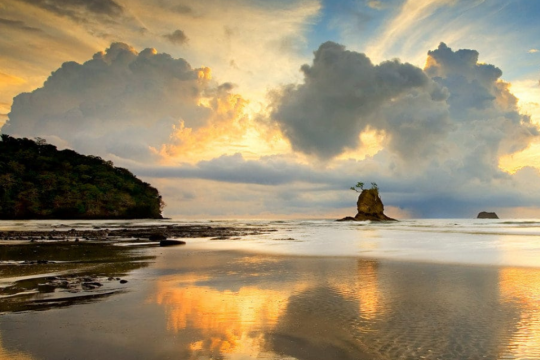
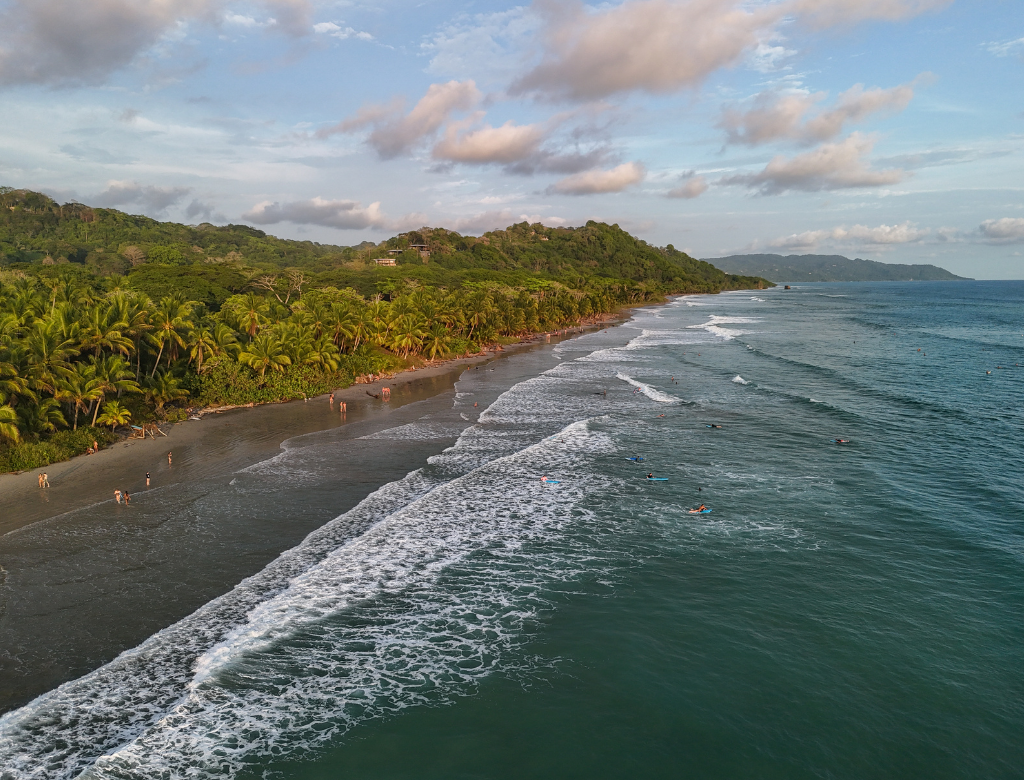
Santa Teresa sits on the southern tip of the Nicoya Peninsula and has become one of the most talked-about destinations on Costa Rica’s Pacific coast. The waves at Playa Carmen are consistent for surfing, the beach is long and uncrowded, the food scene punches above its weight for a small town, and the natural environment — wildlife, jungle, tide pools — is intact and accessible.
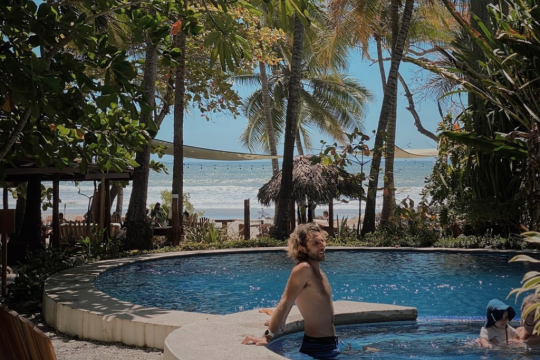
Hotel Trópico Latino sits directly on Playa Carmen and has been operating for over 15 years. Rooms range from garden bungalows to beachfront options. The kitchen at Shambala Restaurant works with ingredients from their own organic garden. Wellness programming through Natural Integrative Wellness is on property. Surf lessons are coordinated through the hotel. For first-time visitors who want to experience the Nicoya Peninsula without piecing together logistics across multiple providers, it’s a practical and well-positioned base.
From Santa Teresa, day trips to Cabo Blanco Nature Reserve, Montezuma waterfall, and Isla Tortuga are all under an hour. The southern Nicoya coast has enough variety to fill a week without leaving the peninsula.
Book in advance for high season (December–April). Popular hotels and tours fill weeks ahead. Don’t assume availability if you’re traveling during this window.
Carry cash. ATMs exist in most towns but run out, particularly in smaller coastal communities. US dollars are accepted almost everywhere; colones are preferred at local markets and smaller vendors.
Tips and taxes: A 10% service charge is standard at restaurants. An additional 13% IVA (sales tax) applies to most goods and services. Check whether prices are quoted with or without tax included.
Learn a few words in Spanish. English is widely spoken in tourist areas, but making the effort with basic Spanish is appreciated and makes interactions in smaller towns significantly easier.
Don’t overpack the itinerary. Costa Rica rewards travelers who slow down. The best experiences here — a morning surf, a wildlife encounter, a meal watching the sunset — don’t come from rushing between destinations. Two or three well-chosen places with real time in each is better than five places seen briefly.
Generally yes. Costa Rica is one of the safer countries in Central America. Standard precautions apply — don’t leave valuables in rental cars, be aware in crowded urban areas, and use reputable transportation.
The colón (CRC). US dollars are widely accepted along the coast and in tourist areas. Credit cards work at hotels, larger restaurants, and established businesses. Smaller vendors are often cash-only.
Ten to fourteen days allows for two or three destinations without rushing. Seven days is workable with one or two regions. Less than five days requires tight focus — choose one region and stay there.
Strongly recommended. Medical care in Costa Rica’s private clinics is good but can be expensive. Travel insurance covering medical evacuation is particularly worth having for remote areas like the Osa Peninsula.
The dry season (December–April) offers the most predictable weather. The green season (May–November) brings lower prices, fewer crowds, and a lush landscape — with afternoon rain that typically clears by evening. Both are valid; it depends on your priorities and budget.
WhatsApp: +506 8453-3422
Website: www.hoteltropicolatino.com